

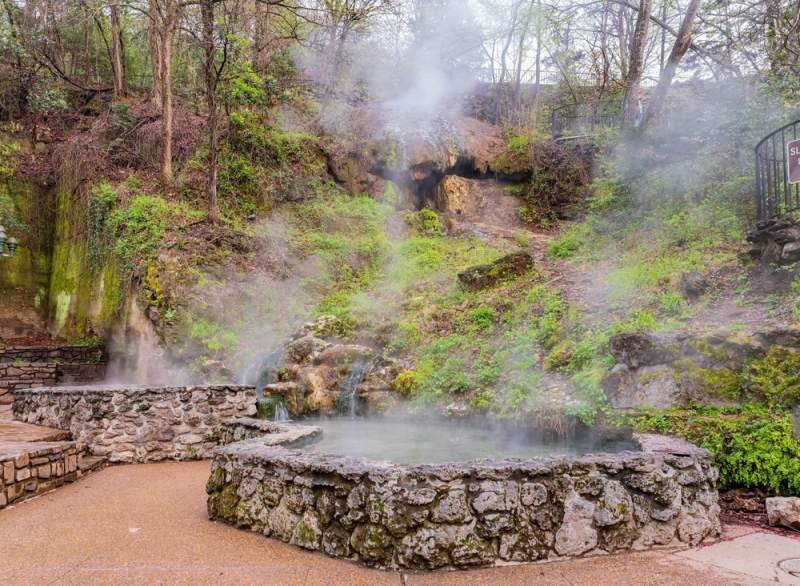
Most people blindly travel to federal reserves expecting untouched forests and complete isolation. Hot Springs National Park destroys that standard expectation. Instead of dropping you into a rugged wilderness, this federal land merges with a commercialized city grid. The government captured massive thermal flows and forced them into structured bathhouses over a century ago. You cannot jump into a boiling river here. To survive, you must deploy a strategy to navigate historic spa treatments, inclines, and massive crowds.
Must Read: 15 Best Places to Visit in Arkansas for Every Traveler
This location does not rely on massive canyons or dangerous wildlife to attract massive crowds. It leverages a geological engine that pushes boiling, mineral-heavy water directly out of the mountain. People flock here specifically to submerge themselves in this regulated, highly therapeutic thermal system.
Unlike isolated federal lands, this reserve completely eradicated the boundary between raw nature and massive commercialized luxury. You step directly off a paved, busy city sidewalk and instantly enter federal territory. This collision of urban infrastructure and protected geothermal activity draws millions of curious urban tourists annually.
Top Pick: Best State Parks in Arkansas With Scenic Views and Trails
Do not just wander the sidewalks staring at old brick buildings. Executing the absolute best things to do in Hot Springs National Park requires targeting the physical thermal infrastructure.
You cannot touch the raw outdoor springs. You must pay cash to sweat inside the Buckstaff Bathhouse, the only facility executing the traditional full-body scrub and soaking regimen.
Stop walking blindly on the ground level. Pay the toll to ride the elevator up the massive steel observation tower, forcing a tactical view of the entire geological basin.
While swimming outside is banned, the park leaves the Hot Water Cascade open. You can stand next to the boiling water and feel the humidity radiating off the exposed rocks.
The historic Bathhouse Row Hot Springs is a massive tourist choke point. You cannot just casually stroll in and expect immediate premium service.
The government completely gutted this massive facility and turned it into a visitor center. You must interrogate the historical exhibits here to understand how intensive the original medical hydrotherapy treatments actually were.
If you refuse the traditional scrub-downs, you must lock down a digital reservation at the Quapaw Baths. It offers communal thermal pools, but the walk-in wait times will destroy your afternoon schedule.
The surrounding mountains are not just decorative backgrounds. The Hot Springs National Park hiking trails physically punish casual walkers with inclines and heat.
Do not waste time on flat, paved paths. Push up this specific route to access exposed novaculite rock formations and command a ruthless, unobstructed view of the surrounding forested valleys.
If you refuse to climb dirt paths, you must march across this brick highway directly behind the bathhouses. It takes you above the city street, shielding you from the chaotic downtown vehicle traffic.
This is not a casual afternoon stroll; it is a brutal, 10 to 14-mile endurance test that rings the outer boundary of the park. You must stockpile water and calories before attempting this remote loop, or the mountain will break you.
Do not let the paved starting point fool you; this route violently forces you up a steep incline directly from Bathhouse Row. It punishes your lungs for over half a mile before dumping you at the base of the mountain observation tower.
You cannot lazily walk out of your campsite and expect flat ground. This trail forces an immediate elevation gain from the campground floor, acting as a steep, punishing connector route to reach the high-altitude mountain loops.
Showing up in the middle of a southern summer is absolute logistical suicide. You must calculate the best time to visit Hot Springs National Park to avoid physical exhaustion.
Submerging into boiling thermal water when it is ninety degrees outside is miserable. You must target the dead of winter, using the freezing external air to contrast the blistering heat of the indoor thermal pools.
If you want to avoid the winter cold, target late October. The temperature drops kill off the massive summer tourist crowds, while the surrounding mountain canopy explodes into red and yellow colors.
You cannot treat this location like a standard wilderness excursion. Surviving Hot Springs National Park requires accepting the reality that you are exploring a heavily paved, highly commercialized urban zone built directly on top of a geothermal weapon. Stop expecting silent, isolated forests and exploit the architecture.
Absolutely not. The federal government prohibits removing geological material from the protected zone. You must drive to commercial mines outside the city limits in Mount Ida to legally extract massive quartz crystals.
Park rangers physically extract samples weekly to test for contaminants. Because the water boils deep underground and is protected by pumps, it remains entirely sterile and is legally rated as highly purified drinking water.
This park relies on a slow, deeply pressurized fault line where rainwater slowly sinks, heats up over four thousand years, and steadily rises without an explosive release.
If you access the modern communal pools at the Quapaw, you are strictly required to wear standard swimwear. They will reject anyone wearing street clothes into the water.
Yes. They are fully permitted on all unpaved mountain routes, but you are strictly mandated to keep them locked on a short leash to prevent the boiling water from burning the animal.
This content was created by AI